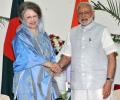
Prime Minister Narendra Modi expressed sadness over the death of former Bangladesh PM Khaleda Zia, acknowledging her contributions to Bangladesh's development and India-Bangladesh relations.
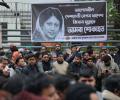
The funeral of Bangladesh's former prime minister Khaleda Zia will be held on Wednesday, and she will be buried with full state honors beside her husband, late president Ziaur Rahman.
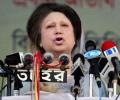
Khaleda Zia, Bangladesh's former first female prime minister and chairperson of the Bangladesh Nationalist Party, has died at the age of 80 after a prolonged illness.

Bangladesh's Prime Minister Sheikh Hasina expressed condolences over the death of Khaleda Zia, acknowledging her role in the country's political history and contributions to democracy.

Bangladesh's former prime minister Khaleda Zia, who was released from jail after the ouster of her arch-rival Sheikh Hasina, has received a renewed passport, her party said on Wednesday.
Former Indian envoys reflect on the life and legacy of Bangladesh's former Prime Minister Khaleda Zia, highlighting her role in restoring democracy and the complex relationship between India and Bangladesh during her tenures.

External Affairs Minister S Jaishankar handed over a letter from Prime Minister Narendra Modi to BNP leader Tarique Rahman, conveying condolences after the death of former Prime Minister Khaleda Zia. Jaishankar's visit comes amid existing tensions between India and Bangladesh.

A senior Bangladesh lawmaker has pointed a finger at former premier Begum Khaleda Zia, claiming that she played a role in a failed coup to overthrow Sheikh Hasina's government with the help of retired and serving army officials.

The Bangladesh Nationalist Party, which Sheikh Hasina has crushed during her multiple terms as prime minister, has stirred into action after its leader Begum Khaleda Zia was released from prison.

A day after her release from house arrest, Bangladesh's former prime minister and Bangladesh National Party (BNP) chairperson Khaleda Zia on Wednesday thanked the people of the country for their 'struggle to make possible the impossible' and said it is not 'anger' or 'revenge' but 'love and peace' which will rebuild the nation.

'They probably imagine any hue and cry in the event Sheikh Hasina is hanged will be shortlived as it happened when Bhutto was hanged in Pakistan in 1979.'
Seeking to give a new dimension to bilateral ties, Prime Minister Manmohan Singh Tuesday said "a strong and prosperous" Bangladesh is in the interest of India and the region.
Sheikh Hasina should draw a veil over the nation's blood-soaked past, moderate her quest for justice and resolve the dilemma of the Bengali and Muslim identities, says Sunanda K Datta-Ray
Khaleda Zia will arrive in New Delhi on March 20 on a three-day state visit, her first since assuming power five years ago.
India and Bangladesh are likely to sign three agreements on trade, investment protection and avoidance of double taxation during Bangladeshi Prime Minister Begum Khaleda Zia's three-day state visit to India from March 20.
India and Bangladesh have recently agreed to provide consular access to arrested insurgents and criminals on reciprocal basis, besides sharing information about their actvities.
The door is open for any diplomat to verify what the government insists, Bangladeshi officials said.

Highlighting the party's broader stance on international relations, he added, "Friends to all, malice to none."
Bangladesh's 'battling begums' are on a hectic last minute campaign trail, which will end at midnight on Saturday, as the country's goes for its first general elections in seven years on December 29. The elections are being held under unprecedented security measures with nearly 48,000 troops and more than 600,000 policemen deployed to guard the polling booths.

A video of Maharashtra Deputy Chief Minister Ajit Pawar recounting a tense helicopter ride with Devendra Fadnavis in July 2024 has resurfaced after Pawar's death in a plane crash. Pawar humorously described his fear during the flight due to bad weather, while Fadnavis remained calm.
Zia returned home late last night after a three-day visit to India.

Now, in exile in India, Hasina, often dubbed the 'Iron Lady' of Bangladesh, watches from across the border as the nation she helped build, and often ruled with a firm hand, grapples with the legacy her rise and fall has left behind.

Bangladeshis are unwilling to give up peace and growing incomes for the chaos witnessed during the BNP-led four-party alliance rule, says Anand Kumar.

Bangladesh is in turmoil, which is not good news for India, which shares a porous 4000 km border with it. There is a danger of fundamentalism growing there, and India has to move in to reset its ties with the new dispensation before China and Pakistan make capital out of it, alerts Ramesh Menon.
22 images that captures glimpses of a most unusual Indian who led the nation for 10 years.
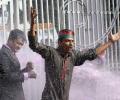
Bangladesh's decision to execute Jamaat-e-Islami chief Motiur Rahman Nizami for war crimes committed in 1971 has provoked anger across the Muslim world. Foreign Secretary S Jaishankar arrived in Dhaka hours after the execution, an important expression of India's support to Prime Minister Sheikh Hasina, explains Rajeev Sharma.
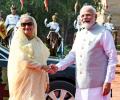
This is possibly the first time Hasina's daughter will be by her mother's side during an official visit to close neighbour and ally India, and analysts believe this to be significant in many ways.

Describing Bangladesh as an 'exceptional neighbour', India on Friday said Modi's 'historic' visit there from Saturday will help the two countries.

'The adversary will always exploit India's anti-national elements.'
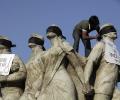
Bangladesh's main opposition Bangladesh Nationalist Party's three top women leaders were arrested on the second day of the 'democracy march' on Monday, as clashes erupted inside the supreme court premises between pro- and anti-government lawyers.

By revising the India-Bangladesh land boundary agreement, the NDA is going for short-term gains and losing the long-term perspective, says Gautam Sen.

'If a bloodbath of this nature can occur in a high security area like Gulshan, I shudder to think how vulnerable other parts of this country are.'

'While Piyush Goel, Dharmendra Pradhan, Rajyavardhan Singh Rathore and a clutch of former bureaucrats including R K Singh, Hardeep Singh Puri and K J Alphons are loyal BJP members, none of them fit the mould of party apparatchiks.' 'In fact, many of the latter kind have been shown the door or have been given reduced charges.' 'That goes to show the prime minister's comfort level in dealing with professionals and administrators and the trust he reposes in them,' says Shreekant Sambrani.
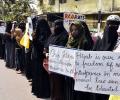
India and Indians can ignore Pakistan, but that cannot be said of other nations in the neighbourhood, where New Delhi's 'Neighbourhood First' policy constantly reverberates. Four of the eight SAARC member-nations are Muslim -- Afghanistan and Pakistan, Bangladesh and the Maldives. The rulers decide the nation's India or anti-India policy in the first two, and street-opinion contributes to the same in the latter two, points out N Sathiya Moorthy.
'Pakistan is paying the price for ignoring secularism. In seeking to be ever more Muslim to define its nationhood, it has become a terrorist haven.'
